


- Fig. 1. Object of study, the Eurasian Jay. The left picture is from the book by M. A. Menzbir [14]. The right picture shows a jay transporting oak acorns in its beak and in the upper part of the esophagus. Drawing by I. A. Murashev. Ink
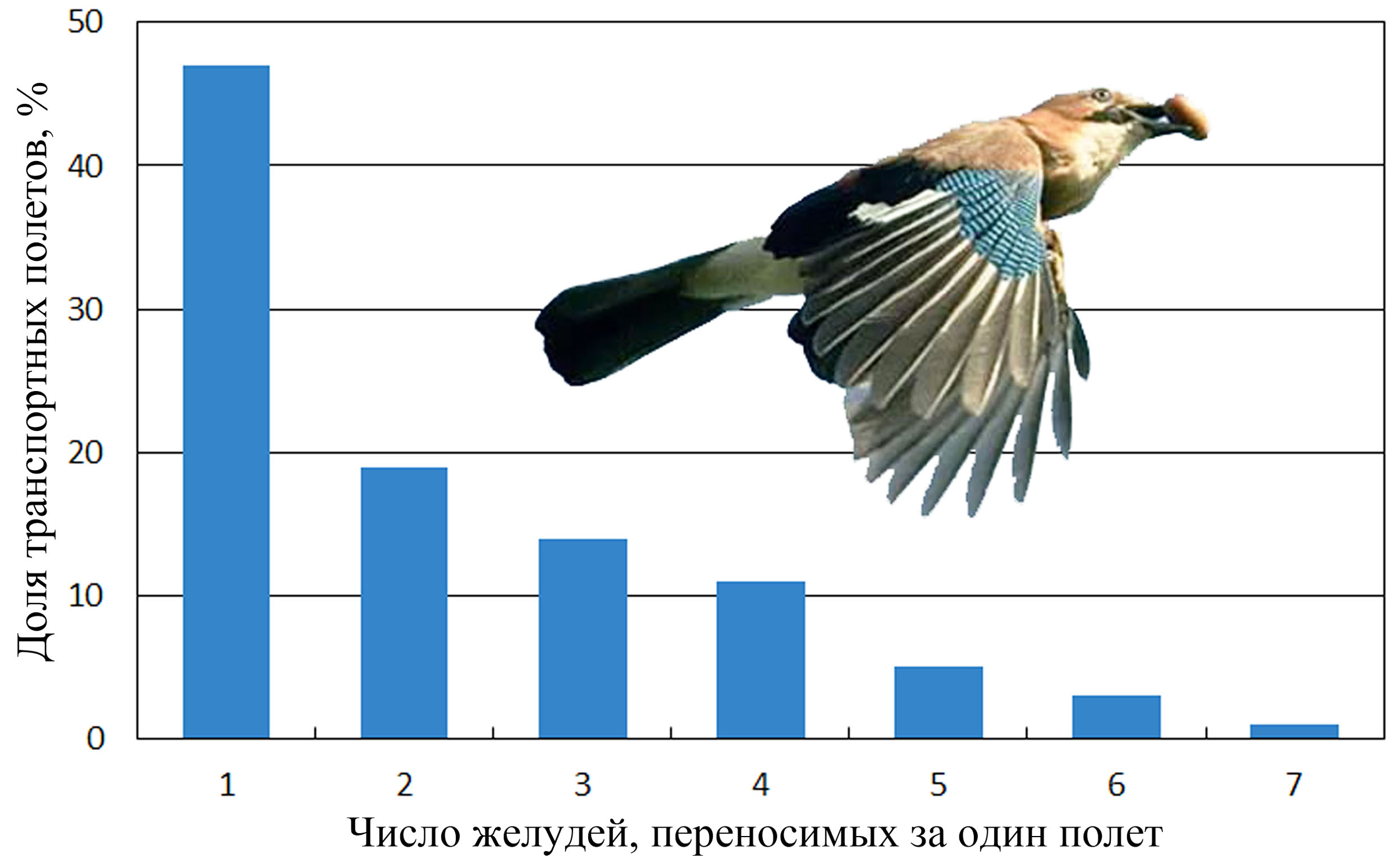
- Fig. 2. The proportion of the Eurasian Jay transport flights with a different number of acorns in the expanded part of the esophagus and in the beak. Vertical axis – percent of transport flights, horizontal axis – the number of acorns that the jay carries during one flight. Number of observations = 111
- Fig. 3. Distribution of jay pantries with acorns to different locations in a coniferous-broadleaf forest. Location of pantries: A – at the bases of the trunks of trees and shrubs; B – on trees at the bases of branches; C – under fallen trees. Total number of discovered pantries = 44
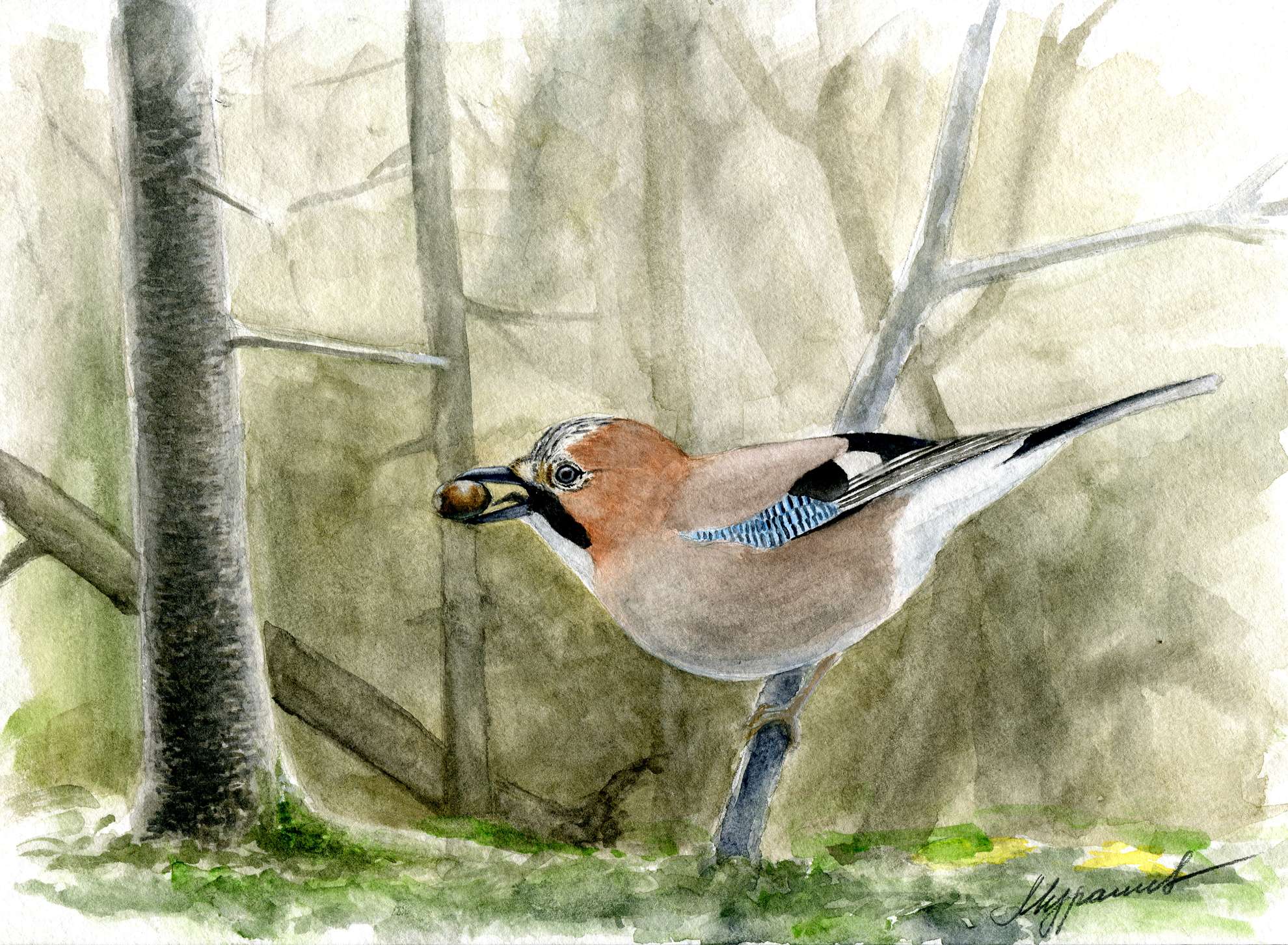
- Fig. 4. The Eurasian Jay before hiding an oak acorn at the base of the spruce tree (Picea abies). Drawing by I. A. Murashev. Watercolor
- Fig. 5. Features and results of the storing activity of the Eurasian Jay: a – the acorn hidden at the base of spruce trunk (Picea abies) was covered with an oak leaf (on the left); б – thawed patch around the trunk of the tree, convenient for extracting supplies; в – juvenile oak at the base of a tree, sprouted from a hidden acorn; г – two juveniles of the common hazel (Corylus avellana), sprouted from the nuts stored at the base of the spruce (Picea abies)
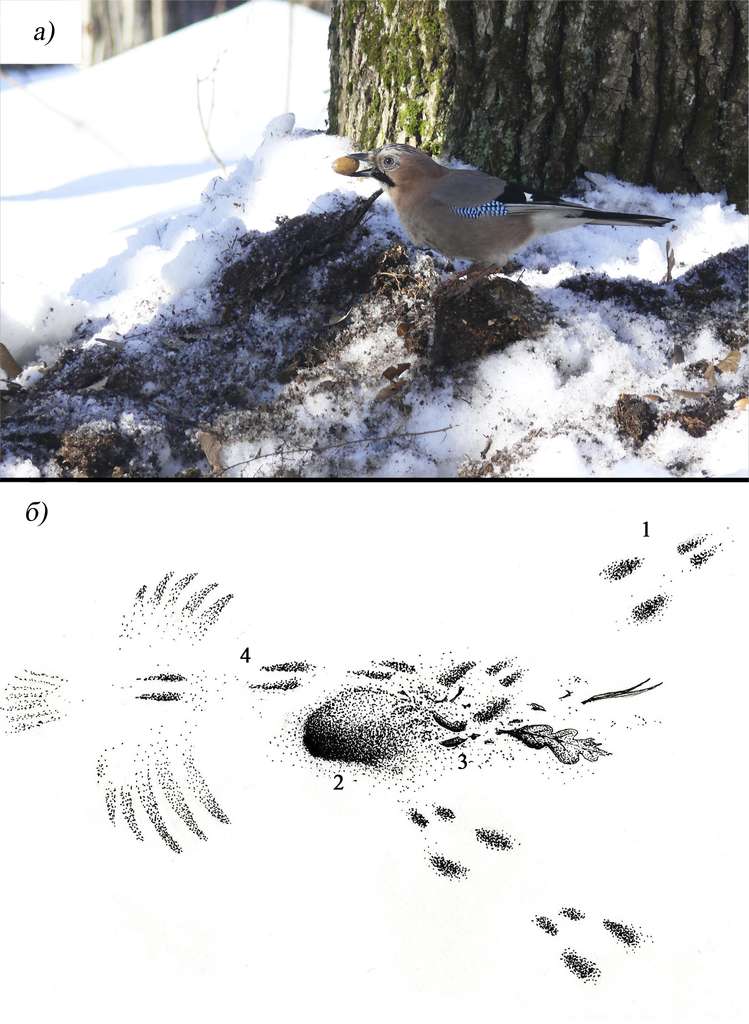
- Fig. 6. Feeding of Eurasian Jays in winter: a – a jay finds an acorn in a boar burrow (Sus scrofa L.); б – with deep snow, jays use burrows of the common squirrel (Sciurus vulgaris L.) which search acorns under the snow cover. Legend: 1 – footprints of a squirrel; 2 – burrow (snow-hole) of a squirrel; 3 – acorn shells left by the squirrel; 4 – tracks of a jay. Drawing by I. A. Murashev. Ink
- Fig. 7. Distance distribution of routes taken by European jays in four types of plant communities and in all types of communities. X – arithmetic mean; M – median; max – maximum value
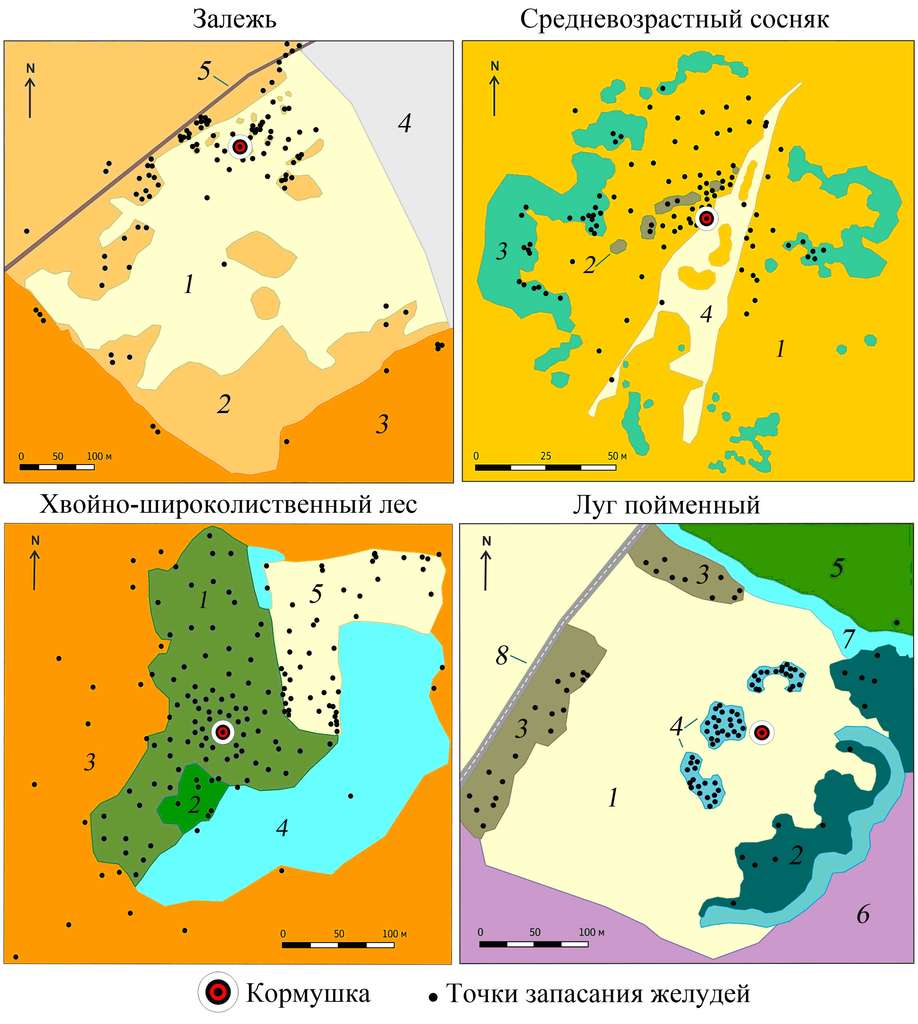
- Fig. 8. Distribution of the Eurasian Jay pantries in different biotopes (parcels). Owergrowth plot (upper-left): 1 – very sparse immature undergrowth of pine and birch; 2 – dense virginile undergrowth of pine and birch; 3 – closed canopy of middle-aged pine forest; 4 – village; 5 – road. Mature pine forest plot: 1 – pine forest with immature undergrowth of oak and spruce; 2 – pine forest with virginile oak undergrowth; 3 – pine forest with virginile spruce undergrowth; 4 – a small glade without undergrowth. Coniferous-broad-leaved forest plot: 1 – old spruce-broad-leaved forest with virginile undergrowth of linden and maple; 2 – old spruce-broad-leaved forest with virginile spruce undergrowth; 3 – medium-aged pine forest with virginile oak undergrowth; 4 – mature birch forest with virginile linden and maple undergrowth; 5 – glade with virginile birch undergrowth. Floodplain meadow plot: 1 – meadow without the undergrowth of trees; 2 – mature sparse oak forest; 3 – young willow forest on riverbed alluvium; 4 – mature willow forest on a boggy oxbow; 5 – old closed oak forest; 6 – reed bog; 7 – river bed; 8 – road
![Fig. 1. Object of study, the Eurasian Jay. The left picture is from the book by M. A. Menzbir [14]. The right picture shows a jay transporting oak acorns in its beak and in the upper part of the esophagus. Drawing by I. A. Murashev. Ink](http://rjee.ru/wp-content/uploads/2018/03/rjee-3-1-2018-1-img-01.jpg)



Copyright © 2016 RJEE. THE ONLINE EDITION IS REGISTERED IN THE FEDERAL SERVICE FOR SUPERVISION OF COMMUNICATIONS, INFORMATION TECHNOLOGY, AND MASS MEDIA. REGISTRATION CERTIFICATE № FS 77 – 62950 from 04.09.2015.