


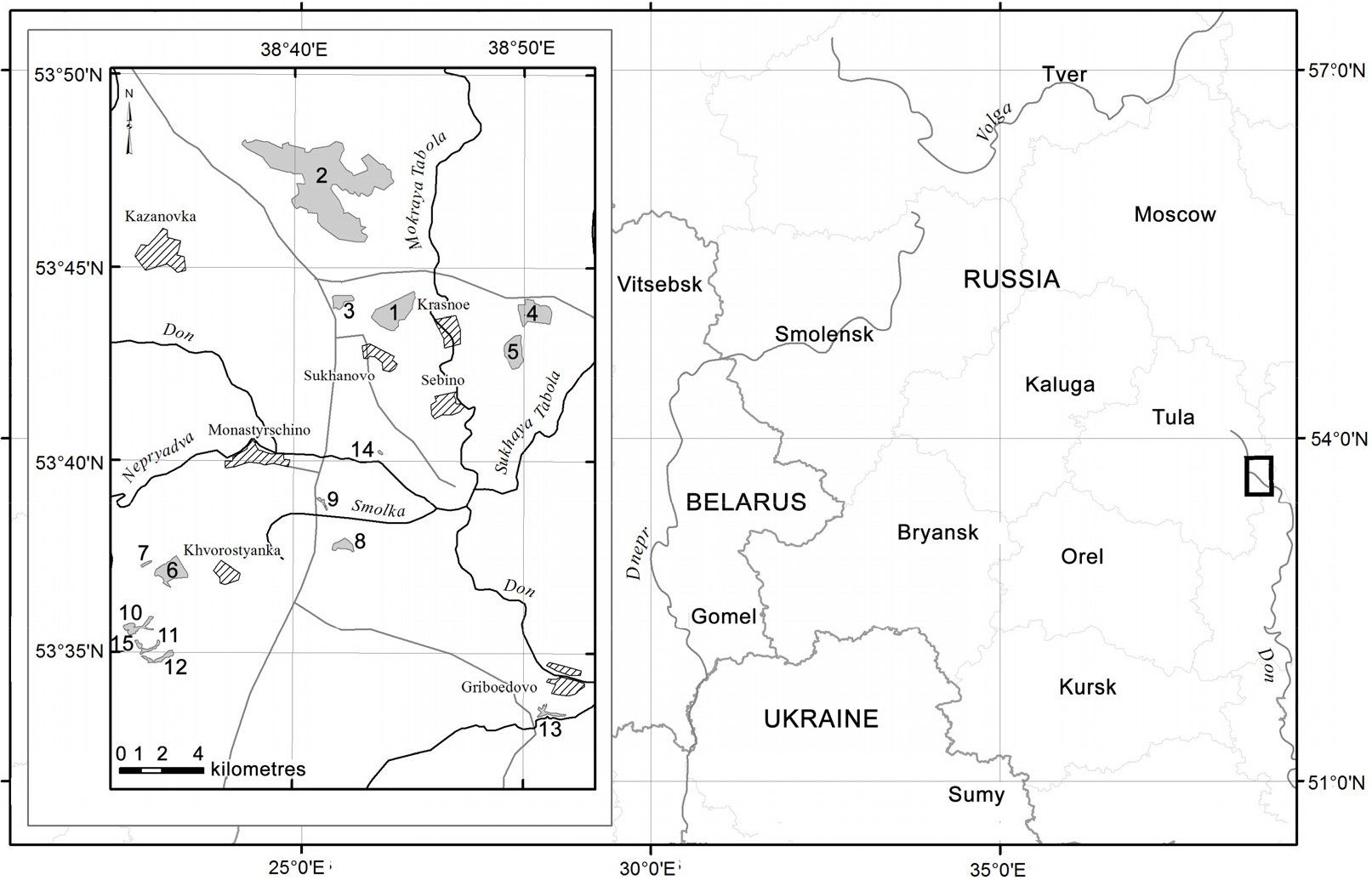
- Fig. 1. Localization of the studied forests on the territory of the Kulikovo Pole Museum-Reserve (designations of forests – in Table. 1)
- Fig. 2. Diagram of cluster analysis of broad-leaved forests syntaxa of the «Kulikovo Pole” Museum-Reserve (measure of Brey-Curtis, Ward’s method). Syntaxa: ass. Fraxino excelsioris-Quercetum roboris: 1 – typica var .; 2 – inops var .; 3 – typica var. Tilia cordata fac .; 4 – typica var. Populus tremula fac.; 5 – Lysimachia nummularia var. Betula pendula fac .; ass. Lathyro pisiformis-Quercetum roboris: 6 – Prunus spinosa var .; 7 – typica var. I – mesophytic forests cluster; II – xeromesophytic forests cluster
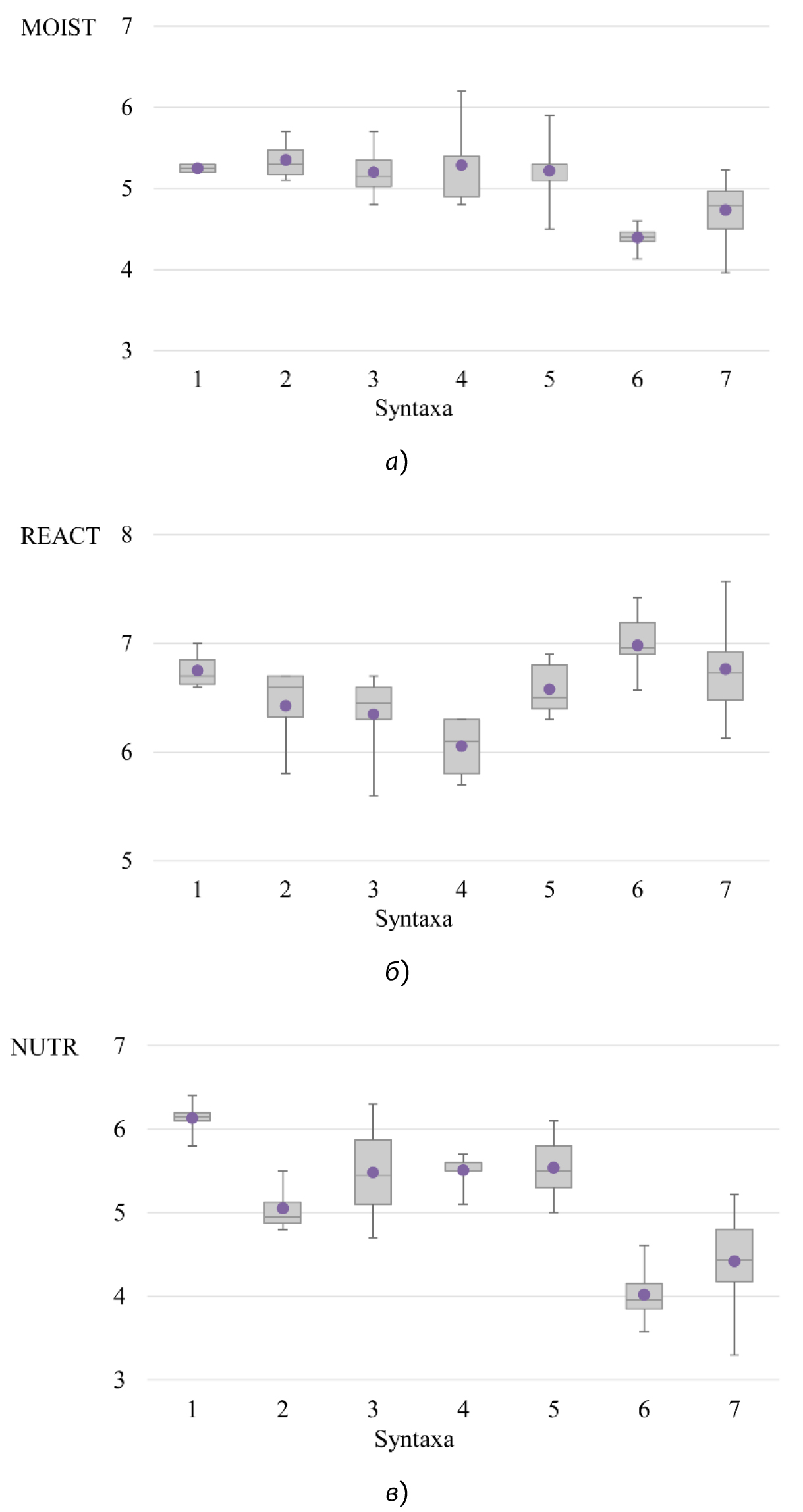
- Fig. 3. Ecological regimes of habitats of broad-leaved forest syntaxa of the Kulikovo Pole Museum-Reserve according to the leading edaphic factors (determined by Ellenberg scales):a – soil moisture (MOIST); б – soil reaction (REACT); в – soil richness in mineral nitrogen (NUTR).Syntaxa: ass. Fraxino excelsioris-Quercetum roboris: 1 – typica var.; 2 – typica var. Tilia cordata fac .; 3 – typica var. Populus tremula fac .; 4 – Lysimachia nummularia var. Betula pendula fac .; 5 – inops var .; ass. Lathyro pisiformis-Quercetum roboris: 6 – Prunus spinosa var .; 7 – typica var
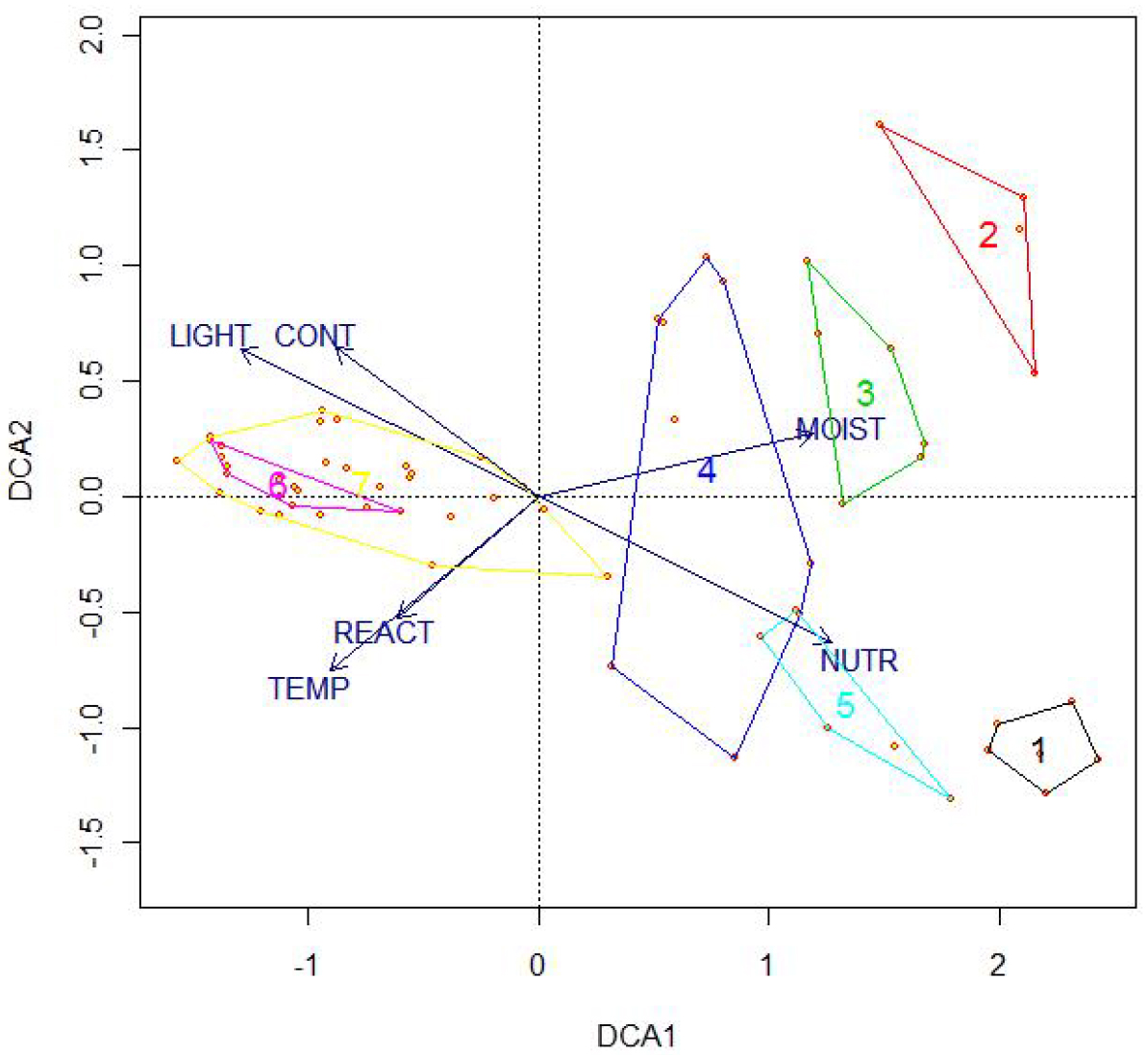
- Fig. 4. DCA-ordination of broad-leaved forests syntaxa of the Kulikovo Pole Museum-Reserve. Vectors of environmental factors: CONT – continentality, LIGHT – illumination, MOIST – soil moisture, NUTR – richness of soil in mineral nitrogen, REACT – soil reaction, TEMP – temperature (determined on Ellenberg scales). Syntaxa: ass. Fraxino excelsioris-Quercetum roboris: 1 – typica var.; 2 – typica var. Tilia cordata fac.; 3 – typica var. Populus tremula fac.; 4 – Lysimachia nummularia var. Betula pendula fac.; 5 – inops var.; ass. Lathyro pisiformis-Quercetum roboris: 6 – Prunus spinosa var.; 7 – typica var.
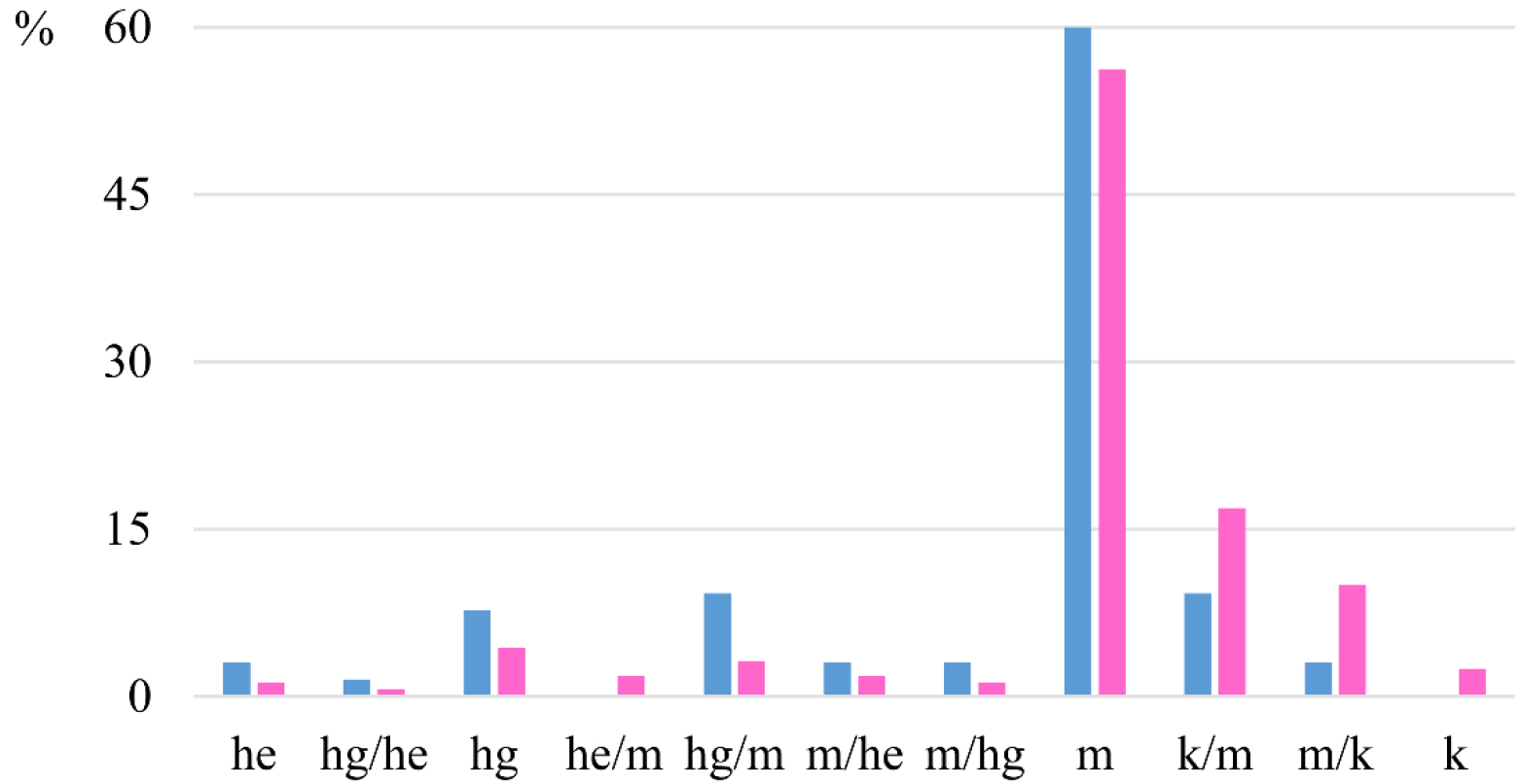
- Fig. 5. Spectra of ecobiomorphs of mesophytic (blue columns) and xeromesophytic (pink columns) forests. Ecobiomorphs: he – gelomorphic; hg/he – hygro-gelomorphic; hg – hygromorphic; he/m – helo-mesomorphic; hg/m – hygro-mesomorphic; m/he – meso-gelomorphic; m/hg – meso-hygromorphic; m – mesomorphic; k/m – xero-mesomorphic; m/k – meso-xeromorphic; k – xeromorphic
- Fig. 6. Spectrum of geoelements and polyzonal groups of mesophytic (blue columns) and xeromesophytic
(pink columns) forests. Geoelements [44]: B – boreal; Bs – subboreal; Js – South Siberian; N – nemoral; Po – pontic; Sp – subpontic; P – plur-regional; polyzonal groups [36]: Pca – sub-Mediterranean-Arctic; Pcb – sub-Mediterranean-boreal; Pct – Sub-Mediterranean-Moderate; Pza – Mediterranean-Arctic Pzb – Mediterranean-Boreal; Pzt – Mediterranean-Moderate - Fig. 7. Phytosociological spectrum of mesophytic (blue columns) and xeromesophytic (pink columns) forests. Class [20]: CF – Carpino-Fagetea sylvaticae Jakucs ex Passarge 1968; TG – Trifolio-Geranietea sanguinei T. Müller 1962; MA – Molinio-Arrhenatheretea Tx. 1937; FB – Festuco-Brometea Br.-Bl. et Tx. ex Soó 1947; CP – Crataego-Prunetea Tx. 1962 nom. conserv. propos .; Qp – Quercetea pubescentis Doing-Kraft ex Scamoni et Passarge 1959; ? – species with unknown affinity to classes
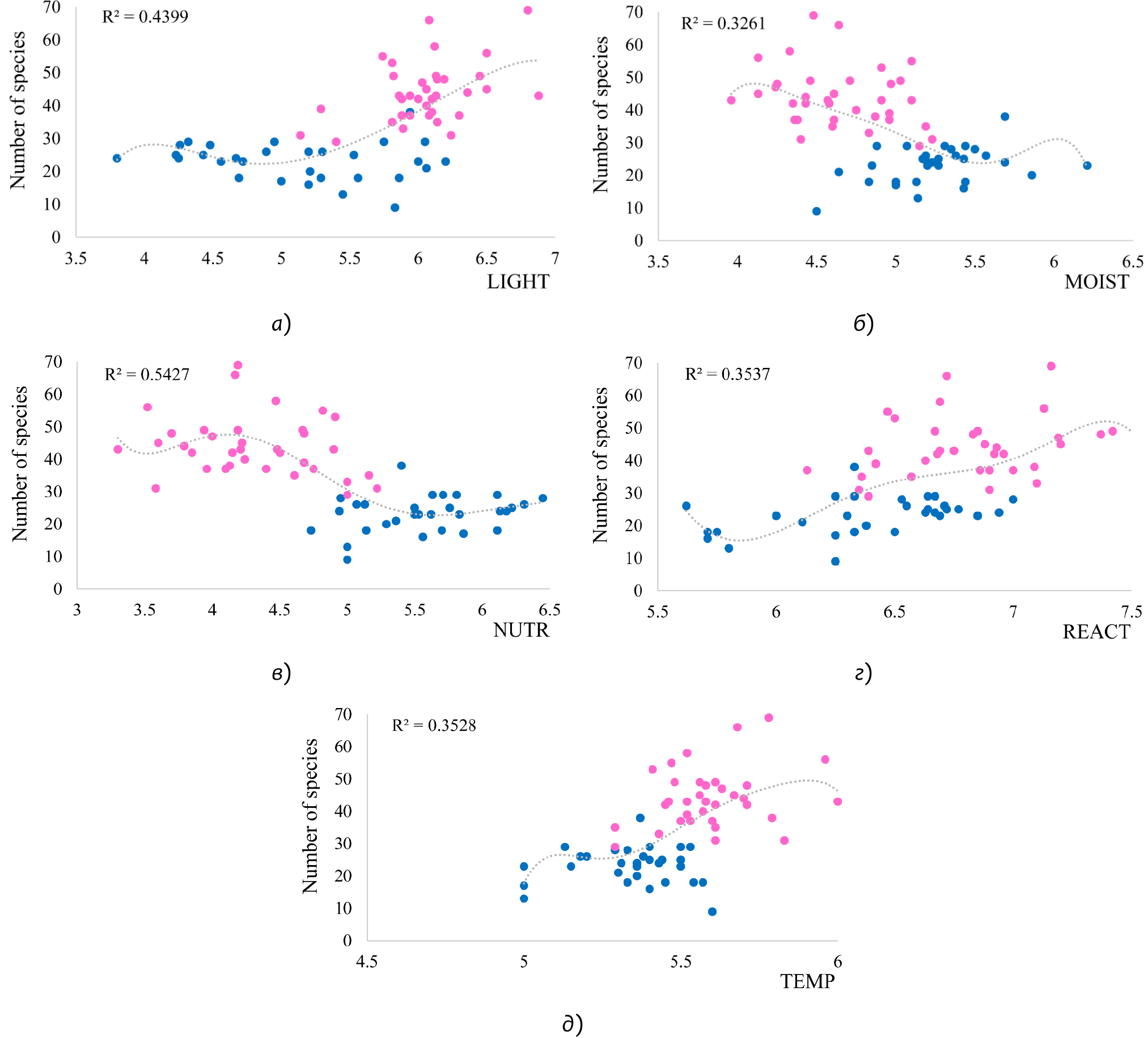
- Fig. 8. Dependence of species richness on the values of environmental factors (determined by Ellenberg scales): a – illumination (LIGHT); б – soil moisture (MOIST); в – soil richness in mineral nitrogen (NUTR); г – soil reaction (REACT); д – temperature (TEMP). Communities of mesophytic forests are indicated by blue dots, xeromesophytic – pink

![Fig. 6. Spectrum of geoelements and polyzonal groups of mesophytic (blue columns) and xeromesophytic (pink columns) forests. Geoelements [44]: B – boreal; Bs – subboreal; Js – South Siberian; N – nemoral; Po – pontic; Sp – subpontic; P – plur-regional; polyzonal groups [36]: Pca – sub-Mediterranean-Arctic; Pcb – sub-Mediterranean-boreal; Pct – Sub-Mediterranean-Moderate; Pza – Mediterranean-Arctic Pzb – Mediterranean-Boreal; Pzt – Mediterranean-Moderate](http://rjee.ru/wp-content/uploads/2021/03/rjee-6-1-2021-3-img-06.jpg)
![Fig. 7. Phytosociological spectrum of mesophytic (blue columns) and xeromesophytic (pink columns) forests. Class [20]: CF – Carpino-Fagetea sylvaticae Jakucs ex Passarge 1968; TG – Trifolio-Geranietea sanguinei T. Müller 1962; MA – Molinio-Arrhenatheretea Tx. 1937; FB – Festuco-Brometea Br.-Bl. et Tx. ex Soó 1947; CP – Crataego-Prunetea Tx. 1962 nom. conserv. propos .; Qp – Quercetea pubescentis Doing-Kraft ex Scamoni et Passarge 1959; ? – species with unknown affinity to classes](http://rjee.ru/wp-content/uploads/2021/03/rjee-6-1-2021-3-img-07.jpg)
Copyright © 2016 RJEE. THE ONLINE EDITION IS REGISTERED IN THE FEDERAL SERVICE FOR SUPERVISION OF COMMUNICATIONS, INFORMATION TECHNOLOGY, AND MASS MEDIA. REGISTRATION CERTIFICATE № FS 77 – 62950 from 04.09.2015.