


- Fig. 1. Location of the meadow and monitoring sites (red circle) within the forest compartment #117 in the Bryansky Les nature reserve. Fragments of forest inventory maps: a) 1988; б) 2006. On the 1988 map, the meadow is marked in white (without forest vegetation). The 2006 map shows that the studied meadow was overgrown with black alder; the remaining remnants of the meadow, which had not yet been covered with forest in 2006, were considered by the taxonomists as heterogeneity within subcompartment #27
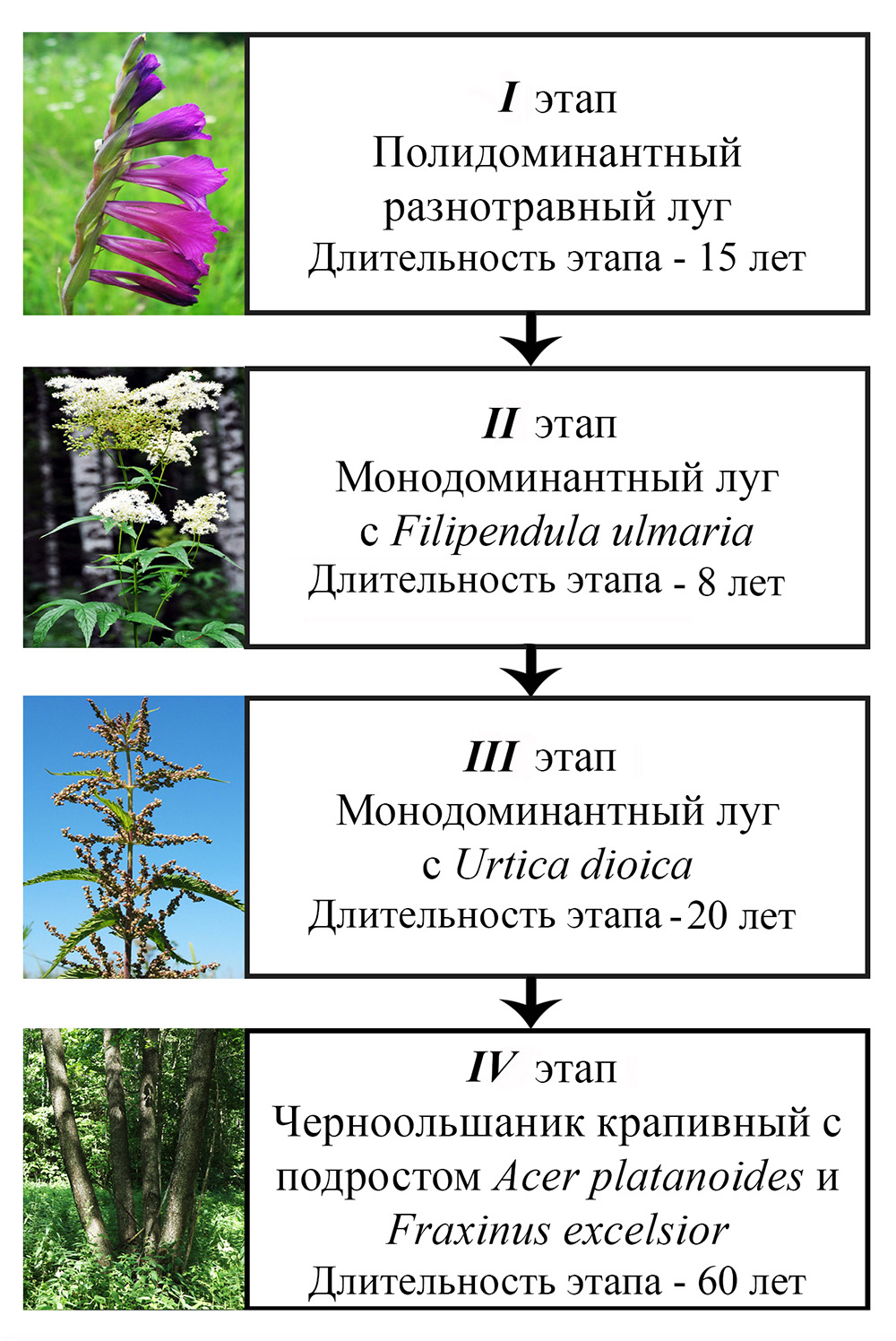
- Fig. 2. Stages of autogenous succession in a wet in-forest meadow (compartment #117, subcompartment #27). Stages I, II and III of meadow development were identified on the basis of long-term monitoring, and stage IV on the basis of expert forecast
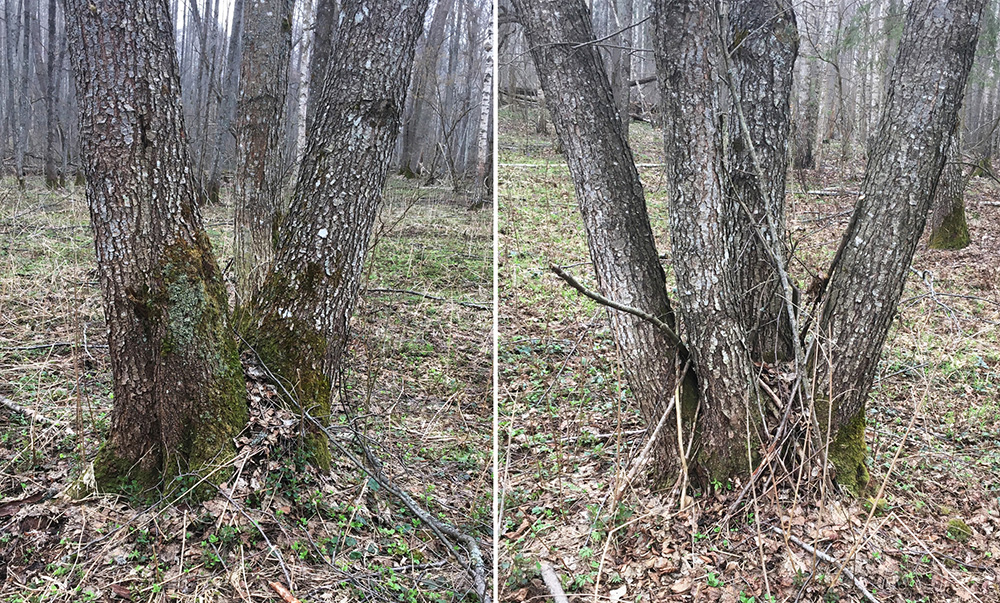
- Fig. 3. Coppiced three-stemmed and four-stemmed black alder (Alnus glutinosa) in a wet meadow within the forest. In their youth, these trees were cut with a scythe or felled with an axe during measures to improve haymaking in a forest glade. Date of photo – April 14, 2021
- Fig. 4. Rare plant species that grew in a wet in-forest meadow in 1998: a – Iris sibirica, б – Gladiolus imbricatus, в – Trollius europaeus, г – Gymnadenia conopsea, д – Dactylorhiza fuchsii, е – D. baltica, ж – Ophioglossum vulgatum. Photo credit: а, б, ж – Maria Gornova; в, д – Olga Ekimova; г – Nikolay Shpilenok; е – Vladimir Korotkov
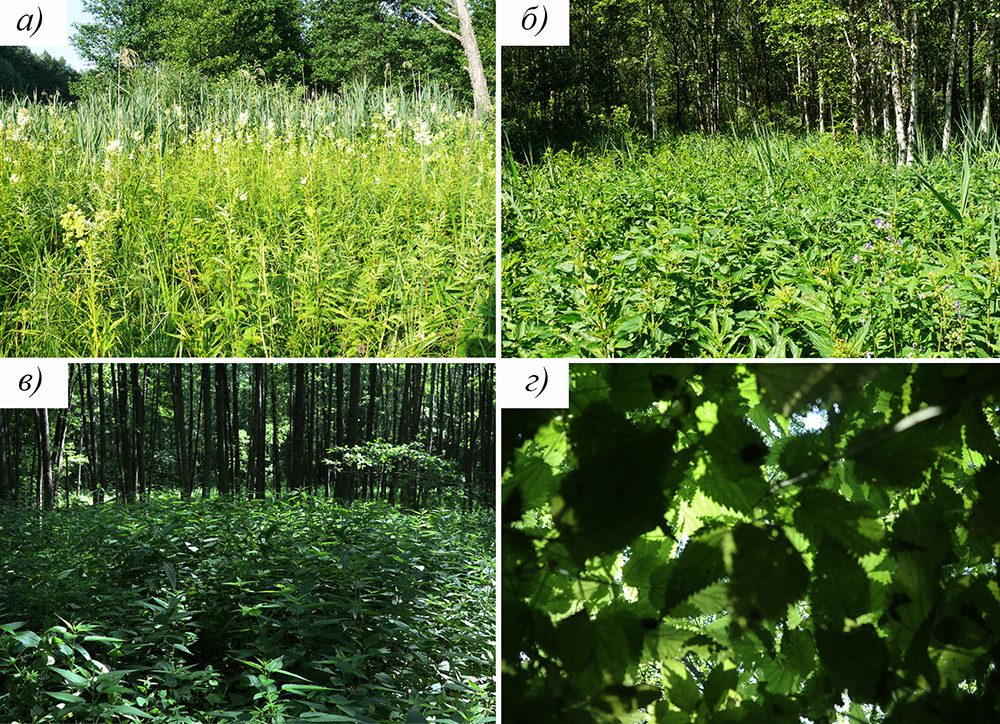
- Fig. 5. Wet in-forest meadow: a) monodominant meadow dominated by Filipendula ulmaria in 2007; б) monodominant meadow dominated by Urtica dioica in 2013; в) monodominant meadow dominated by Urtica dioica in 2017; г) thicket of Urtica dioica in 2017, bottom view
- Fig. 6. Underground parts of generative individuals of Filipendula ulmaria in regularly mown meadow (I) and unmown meadow (II) [41]: 1 – aerial shoot; 2 – hypogeogenic rhizome; 3 – annual growth of the rhizome; 4 – renewal bud; 5 – dormant bud; 6 – adventitious root; 7 – «stump» (rezid); 8 – dead part of the rhizome; 9 – dead adventitious root; 10 – dead leaf
- Fig. 7. Results of DCA-ordination of geobotanical descriptions of a wet in-forest meadow (compartment #117, subcompartment #27), from different years, in the axes of the greatest variation in the floristic composition. Years of description and names of communities: I – 1998, polydominant herb meadow; II – 2007, monodominant meadow dominated by Filipendula ulmaria; III – 2013, monodominant meadow dominated by Urtica dioica; IV – 2017, monodominant meadow dominated by Urtica dioica
- Fig. 8. Basal part of the main shoot of common nettle in the phase of the 13th pair of leaves [55]: I – plant with plagiotropic shoots of the second order on the cotyledon node; II – a plant with orthotropic shoots of the second order on the cotyledon node; 1 – hypocotyl; 2 – epicotyl; 3 – second internode; 4 – orthotropic shoots of the second order; 5 – underground plagiotropic shoots of the second order (hypogeogenic rhizomes); 6 – underground plagiotropic shoots of the third order (hypogeogenic rhizomes); 7 – aboveground plagiotropic shoots of the second order, which can become epieogenic rhizomes if immersed in the soil and take root; 8 – the main root; 9 – lateral roots of the second order; 10 – adventitious roots on the hypocotyl
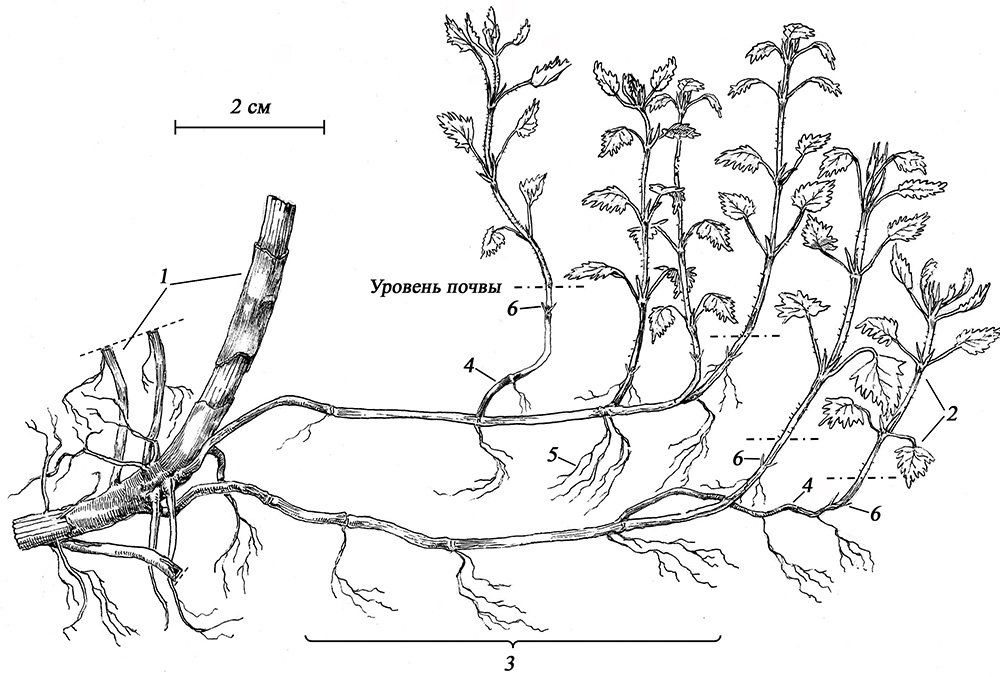
- Fig. 9. Morphological structure of common nettle (Urtica dioica): 1 – the basal part of a partial shoot, five hypogeogenic rhizomes depart from it (September 2020); 2 – partial shoots (April 2021); 3 – branched hypogeogenic rhizome of 2020; 4 – lateral sylleptic shoots that developed from buds without a dormant period during the growth of the maternal shoot (August 2020); 5 – adventitious roots; 6 – boundaries of annual increments. April 2021. The author of the picture is Gleb Shut


![Fig. 6. Underground parts of generative individuals of Filipendula ulmaria in regularly mown meadow (I) and unmown meadow (II) [41]: 1 – aerial shoot; 2 – hypogeogenic rhizome; 3 – annual growth of the rhizome; 4 – renewal bud; 5 – dormant bud; 6 – adventitious root; 7 – «stump» (rezid); 8 – dead part of the rhizome; 9 – dead adventitious root; 10 – dead leaf](http://rjee.ru/wp-content/uploads/2021/06/rjee-6-2-2021-2-img-06.jpg)

![Fig. 8. Basal part of the main shoot of common nettle in the phase of the 13th pair of leaves [55]: I – plant with plagiotropic shoots of the second order on the cotyledon node; II – a plant with orthotropic shoots of the second order on the cotyledon node; 1 – hypocotyl; 2 – epicotyl; 3 – second internode; 4 – orthotropic shoots of the second order; 5 – underground plagiotropic shoots of the second order (hypogeogenic rhizomes); 6 – underground plagiotropic shoots of the third order (hypogeogenic rhizomes); 7 – aboveground plagiotropic shoots of the second order, which can become epieogenic rhizomes if immersed in the soil and take root; 8 – the main root; 9 – lateral roots of the second order; 10 – adventitious roots on the hypocotyl](http://rjee.ru/wp-content/uploads/2021/06/rjee-6-2-2021-2-img-08.jpg)
Copyright © 2016 RJEE. THE ONLINE EDITION IS REGISTERED IN THE FEDERAL SERVICE FOR SUPERVISION OF COMMUNICATIONS, INFORMATION TECHNOLOGY, AND MASS MEDIA. REGISTRATION CERTIFICATE № FS 77 – 62950 from 04.09.2015.